She Bleeds Subspace: Meeting the Astraea
Follow me via: I’ve been carrying this sci-fi world in my head for years now—quietly mapping it, loving it, letting it grow. Writing a whole book feels like wrestling a leviathan, and yeah, sometimes I wonder, “Does anyone even read books anymore?” But that question doesn’t matter. Art is for you first, readers second. If you don’t build the dream, they can’t come live in it. The Birth of a Monster The Astraea is a ship belonging to a large class of space vessels known as Shrikes, utilized by the militarized force of the UEIA—or the United Empire of Interplanetary Authority. A fleet of twelve such ships is anchored to the Life Vessels, star-bound for the furthest reaches of the universe in their mission of human expansion and colonization. Why do “Life Vessels”—or, better known to sci-fi aficionados as ARK ships—need twelve military vessels anchored in their docking bays? In the event of a crisis, a disaster, or an attack, the millions of human beings aboard each Life Vessel require the protection of the UEIA’s military force. Those millions are all in stasis, including the high-ranking individuals who command the ship. Of those not in stasis are military personnel who “sleep” in shifts, and a vessel’s ten different E.M.M.A.s (short for Engineering and Manufacturing Model Automaton). In this story, it’s precisely a crisis aboard one of these vessels that leads to the Astraea being launched by the main character, Morgan Karga, and her companion E.M.M.A., named Andromeda—sans a full crew. The key difference between Life Vessels and these military ships is that the Life Vessels run on brand-new experimental technology that folds space and time to achieve travel. The Shrike vessels use more… established warp techniques, via travel in subspace. And we all know subspace is not sustainable for human life, meaning any living being aboard one of these vessels must be in stasis while in warp. Failure to remain in stasis could have disastrous consequences. Design Deep-Dive: Why She Looks Like That
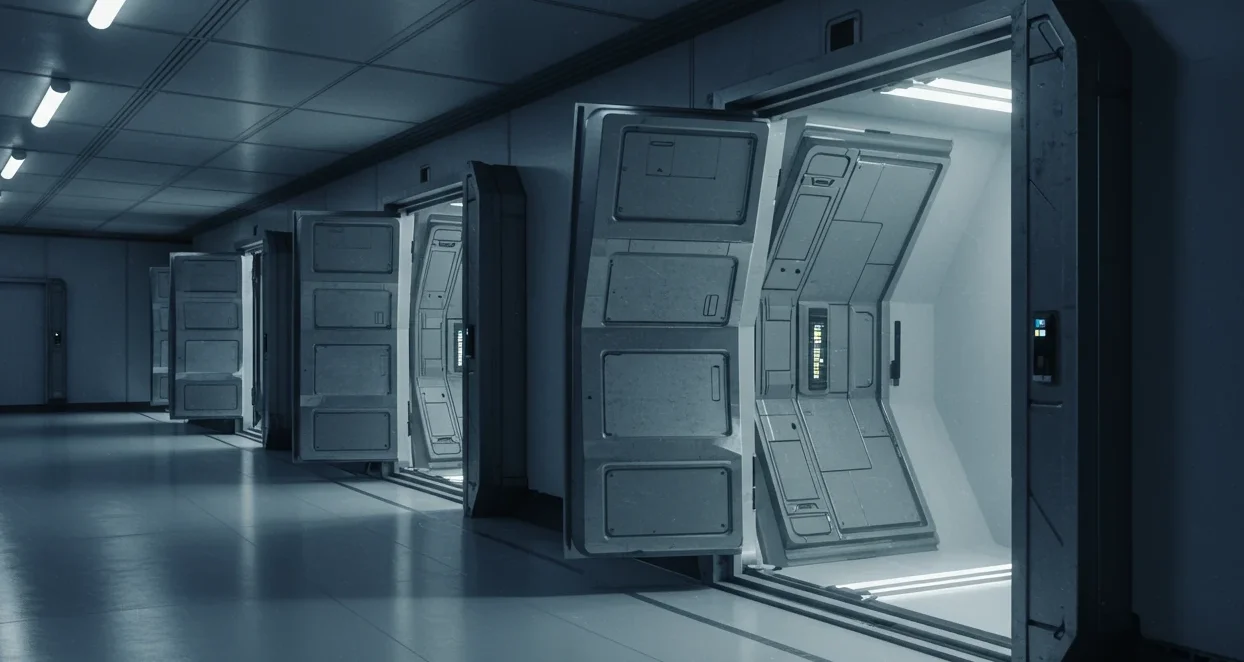
The Astraea is black and, in comparison to a Life Vessel, quite small. But in all actuality, even these ships are very large—especially compared to Tackler variants. This is why they usually require a full crew to navigate space. Morgan, though, isn’t so lucky (the reasons why she’s alone with nothing more than an automaton will be revealed in the story itself). These ships have a central engineering bay where their fission cores are stored, and this is also where an E.M.M.A. would pilot the ship—with no need to physically see the void around them. Not that there’s much to see in subspace in the first place. Aside from its vacuum-resistant paint job, the ship is long, with an underbelly that juts downward. If you were to imagine it yourself, you might think you’re looking at a gun or a rifle with only half a grip. There are no “wings,” as wind does not exist in space, but the engine thrusters on the back are circular and arranged in a trio. Ports and windows exist on all sides, with the largest on the command deck, where a human and a crew might pilot the Shrike vessel. Within its interior, the largest section is the many, many cordoned-off living quarters toward the bottom of the vessel. These are “blocked” off from the rest of the ship, as this is where civilians might take up residence and wouldn’t have much to do with the inner workings. Think Star Trek, but not as pretty. The rest of the ship features sprawling, dimly lit hallways and lifts that lead to mess halls, military quarters, the aforementioned command deck, engineering, medical, a brig, and so on and so forth. It’s very much like piloting around a small city. But vast and liminal if you just so happen to be… by—yourself. Exclusive Excerpt + Commentary Down in its belly, an automaton moves its hands in cyclical, repetitive motion across the holographic monitor that controls the warp and the integrity of the ship. Her body is covered in synthetic nanite flesh, eyes a black and ethereal blue, and she wears a common android’s set of attire—white bodysuit with black stripes that meet her wrists, neck, and ankles, and a single patch across the left of her chest that outlines a logo and the abbreviation, *UEIA*. Andromeda speaks to herself in whispers, “Seven, forty five, nine thousand, break, break, break, seven, twenty six, nine hundred, break, break, break …” The Astraea’s navigation systems do not budge. In a standard starship assigned by the United Empire of Interplanetary Authority—which this ship is not—the automaton typically controls and pilots the vessel when a commander is unavailable, from within the engineering bay. A ship of this size is usually also staffed by a minimum of forty-five different humanoids, all put through a decade-long rigorous and strict training protocol before they’re even remotely allowed to step aboard a UEIA vessel. The commander of the Astraea is one of those people. The rest are not aboard this ship. “I must bring her out of hibernation.” Andromeda speaks to the on-board artificial intelligence, a product of the late twenty-third century. This is still very much rough-draft territory, but I wanted you to taste the tone—the quiet dread, the mechanical loneliness. I’ve been spending a while reading the novel Children of Time, and the voice I’m employing here is heavily influenced by that. The Astraea as Metaphor In reality, the Astraea’s environment is one of severe isolation—not just inside her halls, but in her place in the void itself. It’s no secret I’ve spent long stretches cut off from people, from society. Maybe this ship is my way of translating that pain into something vast and beautiful. Or maybe it’s not a metaphor at all, and I just tricked you~ 😉 Reader Tease: What’s Coming Next After the initial prologue, the story delves into the “launch” of the experimental Life Vessels—and I keep saying “experimental” because we’re dealing with a far-flung society in the 3200s that believes more in technological advancement than safeguards. But it’s the launching of those vessels that sets the real story in motion, and the consequences of the technology humanity has developed. And then we get to know Morgan a bit more, but ten years prior. That’s all I have to share for now, but I wanted this blog entry to be a return to form of how I used to post years ago. You know, about the things that I do, including writing fiction! I hope you enjoyed the read, and until next time~
mkultra.monster is independent, in that it is written, developed, and maintained by one person. Written, developed, and maintained, not for scrapers, bots, scammers, algorithms, or grifters: But for people to follow and read, just like the way it used to be, back in the golden age of the internet.
mkultra.monster is independent, in that it is written, developed, and maintained by one person. Written, developed, and maintained, not for scrapers, bots, scammers, algorithms, or grifters: But for people to follow and read, just like the way it used to be, back in the golden age of the internet.
FEDIVERSE COMMENTSYou can use your Mastodon or other ActivityPub account to comment on this article by replying to the associated post.
|
 ░ Main ∇ H O M E ∇ /about /portfolio /bookmarks /discography /blogroll /podroll /books /gallery /haxpunks░ Gaming /eternal /emojilife /hardcore_flappy /the_sims /second_life░ Tips, Tricks, & More /install_debian /join_activitypub /fediverse_tips /build_a_website /howtoSL /discoverfedi /wayfindr░ The Archives /posts /notes /logs░ Socials /fediverse /bluesky /twitter /threads /instagram /youtube /discord░ Backend /admin |
|
/ 
REVOSA x AyaSysSecond Life
Unique Visits:
Loading...
Cyberpunk fashion & digital accessories for your second life. |
WEBMENTIONS
Have you written a response to this post? Send me a webmention!
📝 How to send a webmention
To send a webmention, your response page must contain an exact link to this post and be publicly fetchable.
After creating your response, paste the URL below. Social posts often need a bridge such as Bridgy before they appear as webmentions here.
Loading webmentions...
0 likes, 0 reposts
Unable to load webmentions.